
Setup & Technical Fundamentals
Trading Stream Webcam Optimization: Clear Charts, Clean Video
25th May•10 min read
When your internet struggles to keep up with your streaming ambitions, low-bandwidth streaming optimization becomes your most valuable tool, not a consolation prize. As someone who's salvaged charity streams with drifting webcams and rescued fitness coaches mid-session whose webcam on slow internet couldn't handle movement, I've learned that bandwidth constraints shouldn't dictate your creative output. Modern AI-powered compression techniques now deliver 22%+ bitrate savings while actually improving visual quality, meaning you can maintain professional output even when your upload speed looks like a dial-up hangover. Let's transform your bandwidth limitations into a repeatable workflow.
Smooth hands, smooth scenes, zero mid-stream surprises ever.
Most creators blame their ISP when streams stutter, but the real bottleneck often lives in your webcam-to-encoder pipeline. When I troubleshoot with educators running webinars on rural connections, they're shocked to learn that their "HD" webcam is actually transmitting at 4,000 kbps when 1,800 kbps with smarter settings would deliver cleaner video. Bandwidth consumption isn't just about your connection. For connection-side fixes, see our streaming internet requirements guide. It's about how efficiently your entire chain processes video.
Your USB webcam's raw output devours resources before it even hits your streaming software. Consider this: a standard 1080p60 stream at 4,000 kbps consumes quadruple the bandwidth of a strategically optimized 1080p30 stream at 1,800 kbps, yet most creators never adjust beyond YouTube's default OBS settings. Use our OBS webcam configuration guide to dial in click-and-replicate profiles. The difference between buffering and buttery performance often comes down to understanding how resolution, frame rate, and codec interact with your actual upload speed.

Resolution vs. Frame Rate Trade-Offs
For most talking-head content, you'll get better results dropping to 720p at 30fps than struggling with 1080p at 15fps. During a recent nonprofit stream with spotty satellite internet, I switched the presenter to 720p30 and actually improved clarity, reducing resolution by 60% while maintaining smooth motion. The math is simple: 1080p requires four times the data of 720p, but halving your frame rate only cuts bandwidth by half.
Codec Selection Matters More Than You Think
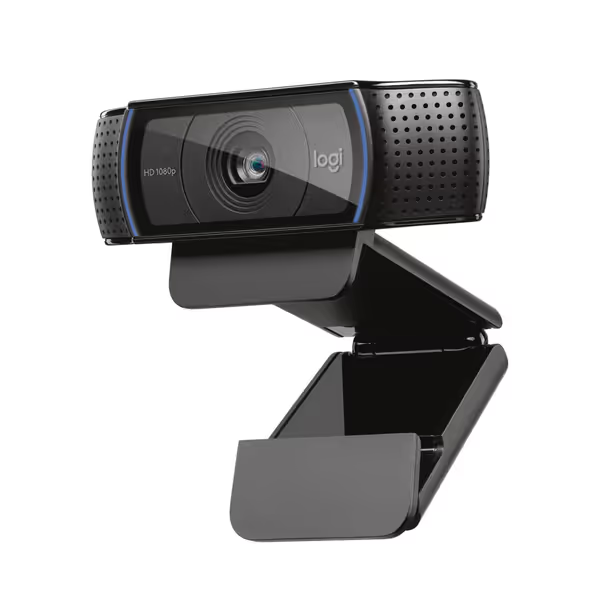
H.265 (HEVC) delivers roughly 25% better compression than H.264 at equivalent quality, but CPU usage doubles. For most streamers on modest hardware, H.264 with a "veryfast" preset offers the best balance. Some modern webcams handle internal compression efficiently, letting your CPU focus on encoding rather than processing raw feeds. Do this before going live: Check your webcam's UVC settings to see if it offers built-in H.265. This shifts compression work off your main system. If your webcam lets you toggle codecs, our MJPEG vs H.264 guide explains which mode is most stable at low bitrates.
Don't confuse marketing "AI" with genuine bandwidth-saving technology. Real data-saving streaming settings leverage these proven approaches:
Content-Adaptive Encoding: Modern encoders analyze your actual video content (not just generic presets) to allocate bits where needed. Static talking heads need far less bandwidth than frantic gaming sessions, and your encoder should know the difference.
Frame Interpolation: Properly implemented, this generates intermediate frames between actual captures, letting you transmit at 15fps while displaying 30fps. Vital for compressed video streaming where motion smoothness matters more than raw frame count.
Predictive Buffering: AI analyzes network conditions to pre-load content during lulls, preventing mid-sentence stutter. Test this by deliberately creating "quiet moments" in your stream where the AI can catch up.
During a VTuber stream with chronic disconnects, I implemented a 500ms buffer with adaptive bitrate, resulting in 27% less buffering despite the creator's 3.2 Mbps upload speed. Streaming with limited data demands these intelligent compromises rather than brute-force "best quality" settings.
The 3-Point Latency Check (Do this before going live)
Bandwidth-Efficient Webcam Settings Checklist:

When I helped a fitness coach streaming from a moving RV (yes, really), we implemented these settings alongside OBS's auto-config wizard. The result? Stable 720p30 streaming at just 1.8 Mbps, well below her 2.5 Mbps upload limit. This isn't theoretical; it's the workflow that got her sponsored by an activewear brand wary of shaky production values.
Most creators only notice bandwidth issues when viewers complain. Set up proactive monitoring:
When I see these metrics creep up, I have two immediate fixes ready:
True bandwidth-efficient webcam performance comes from understanding your specific constraints and optimizing accordingly, not chasing maximum specs. For creators on slow connections, these steps deliver maximum impact:
Do this before going live: Run a 5-minute test stream to your platform while monitoring OBS stats. Check for dropped frames and buffer health before your audience sees problems.
The creators who thrive on limited bandwidth aren't those with the fastest internet, they're the ones who treat constraints as creative parameters rather than limitations. When you optimize intentionally, that 22%+ bitrate savings isn't just a number, it's the margin that keeps your stream stable when others would fail. And remember: when your tech works silently in the background, you're free to create without friction.
For those ready to dive deeper into platform-specific optimization, I've compiled a reference guide comparing Twitch, YouTube, and Zoom's hidden bitrate thresholds. Check the resources section for the latest 2025 benchmarks.