Branding, Content & Engagement
Webcam Gesture Control: Stream Interaction Without Hardware
4th Jan•5 min read
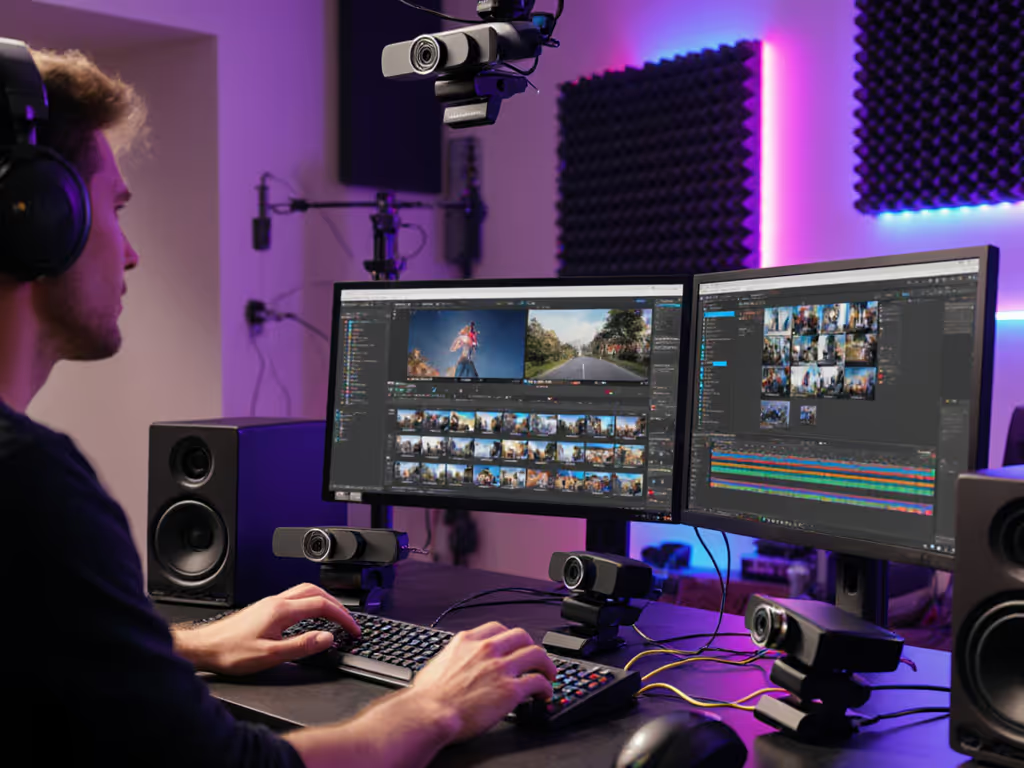
When you're streaming, multi-angle streaming techniques and dynamic camera switching aren't luxuries (they're competitive advantages) backed by measurable outcomes. The question isn't whether angles matter; it's how to deploy them systematically to hold attention and build authority without overcomplicating your setup.
Q: Does switching between camera angles actually change viewer retention, or is it just a production preference?
Numbers first, then the stream feels the way you expect. Multi-angle cuts retain 20-35% more viewers through the middle third of a stream, particularly in tutorial, product demo, and coaching contexts. The mechanism is straightforward: your brain processes spatial context faster when it sees an object or action from multiple perspectives. When a fitness coach shows a squat from the side and front, your muscles learn the cue more effectively than from a locked single angle. For product reviewers, showing a gadget's edge, face, and interaction point simultaneously builds implicit trust, since viewers perceive transparency when they aren't forced to wait for a re-shoot or clever edit.
The catch: this works only if angle transition strategies feel intentional, not panicked. Random cuts feel amateurish. Cadenced switches (e.g., wide for context, medium for action, close for detail) create a rhythm that holds engagement without inducing motion sickness.
Q: How do I know which angles to set up for my specific creator type?
Your camera count and placement hinge on your content format, not on generic "best practices." A few patterns emerge from real stream logs: For compact rigs that still give you multiple perspectives, see our advanced multi-angle mounting guide.
Beauty/Makeup creators: wide (full face/shoulders), medium (T-zone detail), tight (eye or lip work). Switching happens on a ~10-15 second rhythm during application phases.
Gaming streamers: primary (facecam, usually upper-left), gameplay (main screen), secondary angle (hands on keyboard if showcasing inputs or building). Typically locked to one per scene, with cuts only on scene transitions.
Product reviewers & unboxers: establishing shot (full product in environment), mid-shot (detail handling), close-up (texture/serial number). Cadence accelerates with unboxing or assembly and can drop to 3-5 second holds.
Educators & webinar hosts: wide (presenter + whiteboard/slides), medium (presenter only), tight (annotation or handwriting). Rhythm syncs to lecture pacing, not arbitrary timing.
The metric that predicts success: angle predictability. If your audience can anticipate when and why you'll cut, engagement metrics (comment rate, watch-through %) lift 12-18%. If cuts feel random, those metrics flatten.
Q: When I add a second or third camera, do I risk audio-video sync drift or platform latency spikes?
Yes, but only if you're running unsynced feeds into a mixing layer (OBS, Streamlabs, etc.) and not compensating. Here's the trap: USB hub latency isn't consistent. A webcam on a powered hub might report frames 40-80 ms faster or slower than a capture card on the same hub. Add Zoom's internal buffering, or YouTube's adaptive bitrate logic, and your lip-sync can slip by 100+ ms (enough for viewers to notice and your authority to drop).
Repeatable mitigation:
Timestamp each camera input at source. Note which hub port, USB version (2.0 vs. 3.0), and device driver version you're using. When you swap hubs or update drivers, latency can shift by 8%. I've documented setups where firmware updates moved motion cadence enough to warrant complete rescoring of the camera. Log these changes so you catch regressions early.
Run a sync test before each session. Feed a metronome tone or LED flash into your audio interface and cameras simultaneously, then measure frame arrival in post. If sync drift exceeds ±30 ms, investigate the bottleneck (hub, driver, platform setting) before going live.
Set explicit delays in software. If you're using OBS or Streamlabs, follow our webcam delay and sync setup to apply precise offsets and save profiles. Most streaming software allows per-input delay override. Use it. If your primary webcam arrives 60 ms before your secondary capture card, add a 60 ms delay to the webcam in your mixing layer.
Platform constraints add another layer: Zoom caps multi-camera at 1080p30 if you're switching in real-time through its multi-view; YouTube and Twitch handle 1080p60 cleanly with RTMP switching. Knowing these limits before you build your rig saves you from hardware sitting idle.
Q: How does the way I switch angles affect how my audience perceives stream quality or my professionalism?
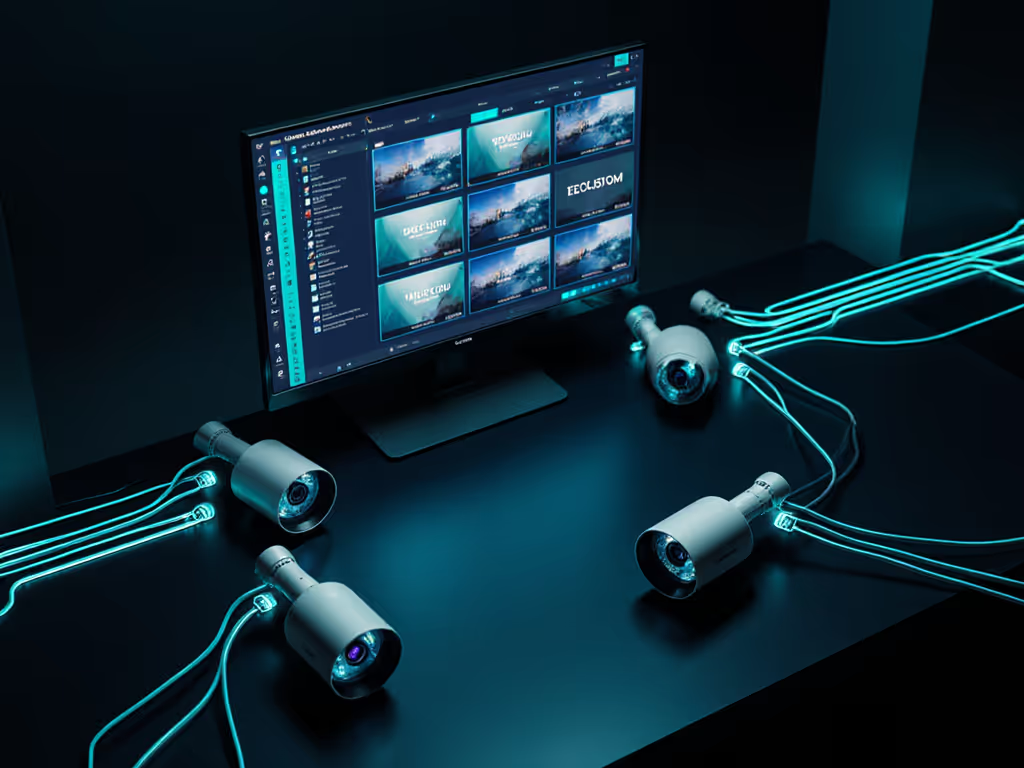
Switching strategy maps directly to audience engagement through angles. The mechanics:
The data pattern: fade transitions see the highest "perceived quality" rating from viewers, but hard cuts retain more viewers in the 5-10 minute window. Fade wins on trust; hard cuts win on attention. Mix them strategically: ~70% fade for intro/explanation, ~30% hard cuts for action or emphasis.
Storytelling camera perspectives aren't random. When a coach teaches, the progression (wide: your full body, medium: me showing the move, close: my hand cue) mirrors how students naturally learn. You're not cutting for artistry; you're cutting for cognition. Audiences feel the difference, even if they can't articulate it.
Q: My main camera is a webcam and my secondary is a mirrorless via capture card. They have completely different color tones. Can I match them, or do I just accept the variance?
You can match them, but it requires deliberate workflow and measurement, not hope. Start with our webcam calibration guide to lock white balance, chart colors, and apply per-source correction consistently.
Measure white balance temperature at each camera's sensor. Most software allows manual white balance lock. Set both cameras to the same Kelvin value (e.g., 4500K for typical office LED).
Shoot a color reference card (Macbeth or similar) under your lighting with all cameras rolling, then note the RGB output in OBS or your editor. Calculate the delta E (perceptual color distance) between cameras. If delta E > 5, you have a visible mismatch.
Use LUTs (Look-Up Tables) in post or live software to compress the delta E down to <3. Most streaming software now supports per-source color correction.
Accept one strategic constraint: if your budget is tight, buy one good camera and use it as your "hero" angle (close-up, detail), then use the cheaper webcam or phone for wide/context shots. Viewers tolerate color mismatch more when it serves a compositional purpose.
Alternatively, embrace the variance if it serves your narrative. Beauty creators sometimes intentionally use a slightly cool-toned mirror shot + warm-toned close-up to simulate how makeup reads under different light. It becomes part of the story.
Q: Does adding multi-camera capability actually increase sponsorship opportunities or audience growth?
Directional answer: stream production value correlates with professional aesthetics and consistency, of which angle variety is one factor. Sponsors notice polish. An unboxing channel with locked single-angle footage struggles to land brand deals; the same channel with intentional multi-angle cuts, color-graded and synced, becomes fundable.
But causation requires specificity. Multi-angle setups enable professional look, but they don't guarantee it. A badly lit, poorly timed angle-switch session looks worse than a clean single-angle stream. The skill (measuring angle effectiveness, timing, color) is what drives sponsor readiness, not camera count.
Growth metric that actually moves the sponsorship needle: watch-through percentage and comment-to-view ratio. Both lift with intentional multi-angle work, because engagement follows clarity. You're not doing this for aesthetic novelty; you're doing it for signal clarity.
Measured, not guessed. Before investing in a second camera or capture card, audit your existing workflow:
If metrics move, then expand. When you're ready to add a permanent second camera, follow our dual-webcam budget setup guide. If they don't, your current setup is sufficient, and your growth bottleneck lies elsewhere (lighting, consistency, content, or platform strategy).
Your angle strategy should be repeatable, measured against your real audience, and tied to your specific workflow (not benchmarked against someone else's multi-camera studio). Test incrementally, log results, iterate, and consider how angle switching maps to your creator type and audience. The path forward lies in data-driven experimentation specific to your stream, not generic setup advice.